
Home · Resource Center · New build vs resale
New Build vs Resale Rental: Capex, Rent and Cash Flow
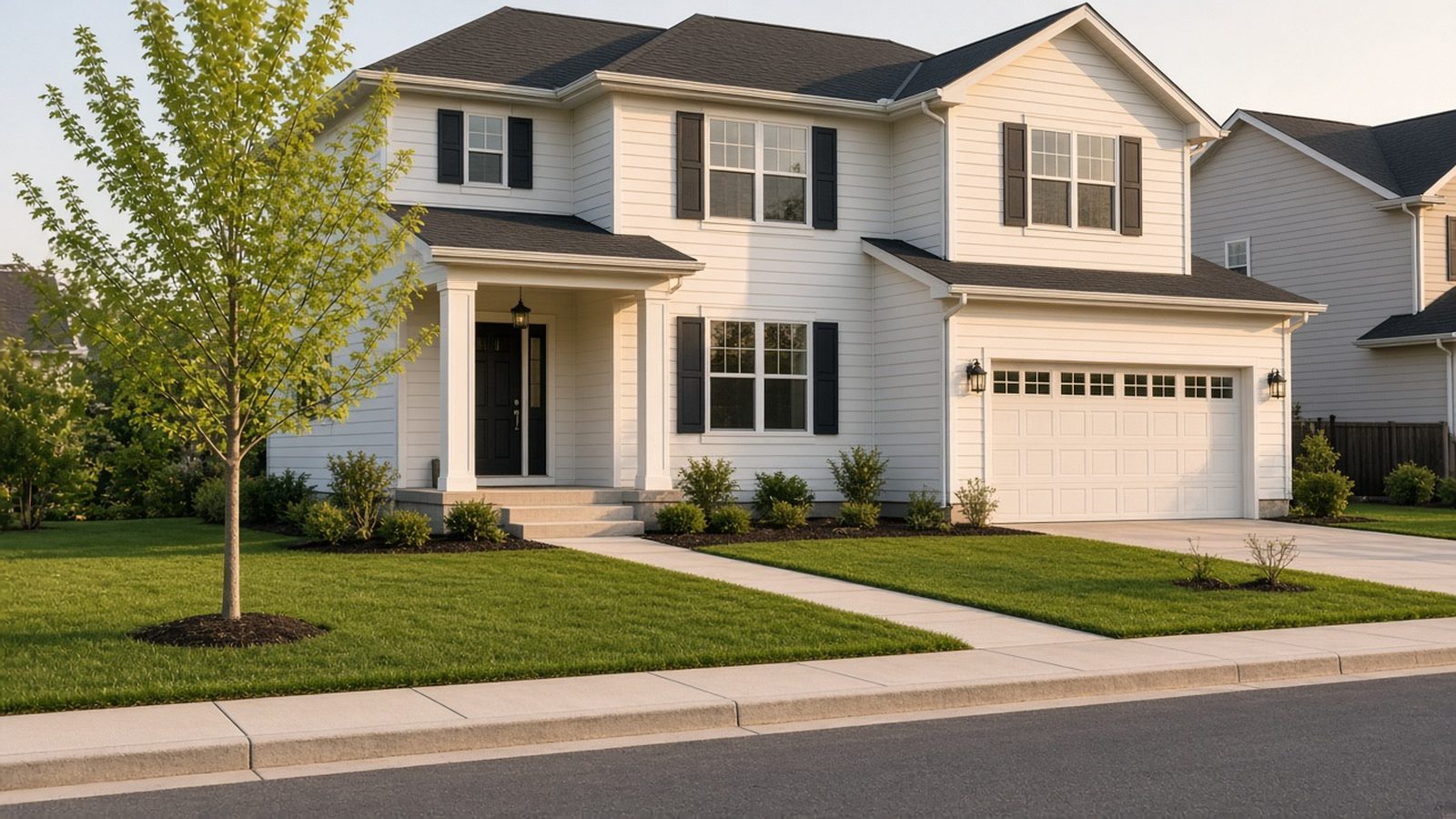
A newer house can push the roof and the HVAC into later years and still lose on price. On the worksheet, a $310,000 new build at $1,950 rent cash-flows $2,019.43 a year worse than a $250,000 resale at $1,800, before any capex reserve. A labeled reserve of $300 a month on the resale and $50 on the new build flips that gap. The dollars are round inputs, not a rent premium from a dataset.
By RentalAnalytics Editorial Team · Published November 16, 2026
Key takeaways
- Price, the rent you can support, and the capex reserve are the three levers.
- The rent estimator has no year-built field. Do not invent a percent premium. Type two rents you will defend.
- CapEx reserves per unit keeps a roof and an HVAC system out of NOI. The analyzer's maintenance line is not that reserve.
- On these inputs the resale leads by $2,019.43 a year before reserves. After a $3,600 reserve on the resale and a $600 reserve on the new build, the new build leads by $980.57 a year. The $60,000 price gap is still paid at closing.
- Turnkey rentals: pros, cons, and the numbers to check covers a seller package. This page does not repeat it.
Which three numbers move the comparison?
A higher price raises the loan, the down payment, and the cash you bring, and it lowers the cap rate unless NOI rises in proportion. Rent may be higher in a newer finish, or it may not, if the new house sits farther from jobs. Stessa's article, last updated November 6, 2025, says the builder has done the location scouting and the house may sit farther from an urban center, with fewer transit options, and that a resale can have a rental history a new build does not. This page does not turn either point into a percent. The estimator has no year built.
A new roof, HVAC, plumbing, and electrical panel can stay quiet for a while. That deferral is cash only after you write a reserve for each house. CapEx reserves per unit separates that bucket from routine repairs. Stessa describes builder warranties as typically covering workmanship and materials for one to two years, with major structural defects usually covered up to ten years, and notes that a warranty can be worthless if the builder is gone. A warranty is a contract term, not a reserve of zero. A BiggerPockets article dated December 16, 2025, and presented by Lennar Investor Marketplace, argues that new systems can cost less to own early. This page does not copy that article's repair statistics or its price comparison.
What does a round side-by-side show?
Shared inputs: vacancy 5%, taxes $3,600 a year, insurance $1,200 a year, repairs $150 a month, management 8% of effective gross income, 25% down, 7% interest, 30 years. The resale is $250,000 at $1,800 rent. The new build is $310,000 at $1,950 rent. The $150 rent gap is an input, not a sourced premium. Capex reserves, subtracted after the analyzer, are $300 a month on the resale and $50 a month on the new build. Those reserves are inputs too.
| Line | Resale | New build |
|---|---|---|
| Price | $250,000 | $310,000 |
| Loan at 25% down | $187,500 | $232,500 |
| Monthly principal and interest | $1,247.44 | $1,546.83 |
| Monthly NOI | $1,023.20 | $1,154.30 |
| Monthly cash flow before the reserve | -$224.24 | -$392.53 |
| Capex reserve, not in the analyzer | $300.00 | $50.00 |
| Monthly cash flow after the reserve | -$524.24 | -$442.53 |
| Cap rate | 4.91% | 4.47% |
| Cash invested, including 3% closing costs | $70,000 | $86,800 |
Resale: vacancy $90, effective gross income $1,710, management $136.80, operating expenses $686.80, NOI $1,023.20 a month or $12,278.40 a year, cap rate 4.91% on $250,000. New build: vacancy $97.50, effective gross income $1,852.50, management $148.20, operating expenses $698.20, NOI $1,154.30 a month or $13,851.60 a year, cap rate 4.47% on $310,000. The rent gap leaves $131.10 a month of extra NOI, or $1,573.20 a year, after 5% vacancy and 8% management. The new payment is higher by $299.39 a month. Annual debt service is $14,969.31 and $18,561.94, a difference of $3,592.63. Extra debt minus extra NOI is $2,019.43 a year, so the resale cash-flows better before any reserve. Both cash flows are negative at 7% and 25% down.
Subtract the reserves and monthly cash flow becomes -$524.24 and -$442.53. The new build is ahead by $81.71 a month, or $980.57 a year. The $3,000 reserve gap ($3,600 minus $600) more than covers the $2,019.43 operating-and-debt gap. If your reserve gap is smaller than $2,019.43, the resale still leads. Cash invested is $70,000 and $86,800. The $16,800 difference is 25% of the $60,000 price gap plus 3% of that gap. Cash-on-cash before the reserve, on the tool's cash-invested figure, is -3.84% and -5.43%.
When does the resale still win?
The resale wins on this sheet when the systems you inspected do not need a $300 reserve. Drop that reserve until the annual gap versus $600 is under $2,019.43 and the resale leads again. It also wins if the rent premium disappears. Set both rents to $1,800 and the new build's NOI advantage goes to zero while the extra payment remains. The new build's deferral matters when you will actually hold the older replacement bill and you will not hold the same bill on the new one. It does not matter if the warranty excludes the item, if the builder is gone, or if the "new" house is a finished rehab on old systems. That last case belongs on the turnkey page.
Stessa's cons in the same November 6, 2025 article are prices that are rarely negotiable, possible HOA dues, and rental caps. Dues are not in the table. If the new build has them, fold them into the maintenance field the way the condo worksheet does and label the split. A rental cap can zero the rent. No reserve math repairs a house you cannot lease.
How do you test the three levers?
Run the rent estimator for the ZIP, bedrooms, and property type, and read the market-blend hero. Leave the 40th / voucher column out unless the tenant will use a voucher. A second run will not invent an age premium, because there is no year-built control. Two rents need two inputs you can defend.
In the cash flow analyzer, the resale run is price 250000, down payment 25, interest 7, term 30, rent 1800, vacancy 5, taxes 3600, insurance 1200, maintenance 150, and management 8. The new-build run changes price to 310000 and rent to 1950. The tool rounds to the nearest dollar: cash flow -$224 and -$393, NOI $1,023 and $1,154, principal and interest $1,247 and $1,547. Subtract $300 and $50 after that screen. The operating expense benchmark checks taxes, insurance, the $150 repairs, and management. It is not a capex model.
FAQ
Does a new build automatically cash-flow better than a resale?
No. On the worksheet the new build rents for $150 more and still cash-flows worse before any reserve, because the loan costs $299.39 more a month. The resale is ahead by $2,019.43 a year until you subtract a larger reserve.
Where does the capex reserve go in the cash flow analyzer?
Outside the result. Maintenance is a recurring repair allowance. Subtract the reserve after you read cash flow, and keep it out of NOI unless you are deliberately changing the definition.
What rent premium does a new build get?
This page does not publish one. The estimator has no year-built field. The $1,800 and $1,950 rents are worksheet inputs.
When does the resale still win on these inputs?
Before the reserve, and whenever the capex gap is smaller than $2,019.43 a year. Extra NOI on the new build is $1,573.20. Extra debt service is $3,592.63.
What does a builder warranty cover?
Stessa's November 6, 2025 article says warranties typically cover workmanship and materials for one to two years, and major structural defects usually up to ten years. The same page says the warranty can be worthless if the builder goes out of business. Read the contract.
Sources
- Stessa, "New build vs. resale debate" (last updated November 6, 2025) - https://www.stessa.com/blog/new-build-vs-resale-debate/
- BiggerPockets, "New Construction vs. Older Homes" (December 16, 2025, presented by Lennar Investor Marketplace) - https://www.biggerpockets.com/blog/new-construction-vs-older-homes-why-new-builds-cost-less-than-you-think
- RentalAnalytics, CapEx reserves per unit - https://rentalanalytics.com/blog/capex-reserves-per-unit
- RentalAnalytics, Turnkey rentals: pros, cons, and the numbers to check - https://rentalanalytics.com/blog/turnkey-rentals-pros-cons-and-the-numbers-to-check
- RentalAnalytics, Cash Flow Analyzer - https://rentalanalytics.com/tools/cash-flow-analyzer
- RentalAnalytics, Operating Expense Benchmark - https://rentalanalytics.com/tools/opex-benchmark
More on RentalAnalytics → all articles · all tools · city reports